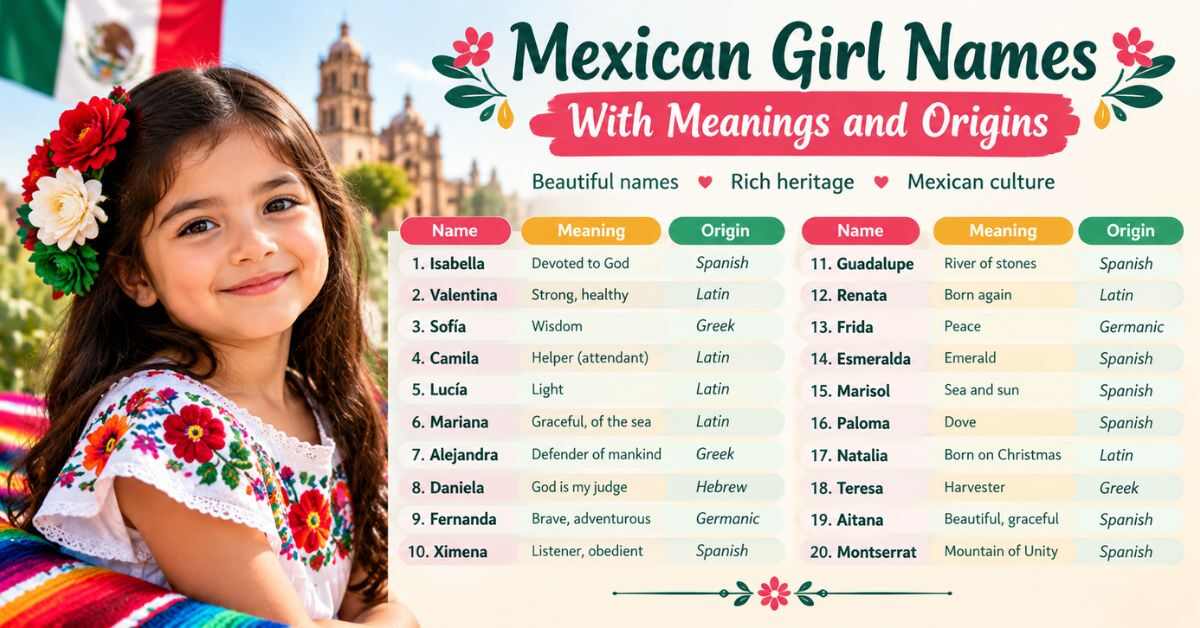
Names from Mexico carry the music of Spanish, the depth of Catholic tradition and the poetry of ancient Indigenous languages. That mix gives families a wide and beautiful range to explore, and many choices are easy to say in any country. If you are searching for Mexican girl names, this list gives you 60 options, each with its origin and meaning. They are grouped into classic Spanish names, modern favorites, faith-inspired picks, Indigenous names and affectionate nicknames. Read through each section, note the ones that stay with you, and use the tips at the end to choose with confidence.
Read More: https://topwishesworld.com/biblical-girl-names/
Where These Names Come From
Most names used in Mexico arrived with Spanish settlers, and many trace back to Latin, Greek, Hebrew and Germanic roots. Others come from Indigenous languages such as Nahuatl, the language of the Aztecs, and Mayan languages in the south. Smaller communities add languages like Purépecha and Totonac. Catholic tradition has shaped naming for centuries, so saints and titles of the Virgin Mary appear again and again. Many families also give a girl two first names, such as Ana Sofía or María Elena, and every person carries two surnames, one from each parent.
Classic Spanish Names
These names have been loved for generations. They are graceful, familiar and easy to pair with almost any surname.
- Carmen (Latin/Hebrew): Means “song” in Latin and is also tied to Mount Carmel. Simple, warm and timeless.
- Rosa (Latin): Means “rose.” Short and classic, with Rosita as a sweet pet form.
- Lucía (Latin): Means “light.” Bright and elegant, with Lu as an easy nickname.
- Isabel (Hebrew): The Spanish form of Elizabeth, meaning “my God is an oath.” Regal and flexible.
- Elena (Greek): Often linked to “torch” or “bright one.” Smooth, simple and well loved.
- Beatriz (Latin): Means “she who brings happiness.” Cheerful, with Bea or Beti as short forms.
- Josefina (Hebrew): The feminine form of José, meaning “God will add.” Sweet, with Fina or Pepa as nicknames.
- Leticia (Latin): Means “joy” or “gladness.” Bright and upbeat.
- Verónica (Latin/Greek): Often linked to “true image” or “bringer of victory.” Elegant, with Vero as a nickname.
- Teresa (Greek): Its meaning is debated, with suggestions such as “harvester.” Gentle and traditional, with Tere as a common short form.
- Alejandra (Greek): Means “defender of mankind.” Strong and confident, with Ale or Jandra as nicknames.
- Gabriela (Hebrew): Means “God is my strength.” Lively and popular, with Gaby as a friendly short form.
Modern Favorites
Many families now lean toward fresher choices. These names appear often in Mexican classrooms today and travel well across languages.
- Victoria (Latin): Means “victory.” Strong and bright, with Vicky as a playful form.
- Isabella (Hebrew): The Italian form of Elizabeth, meaning “my God is an oath.” Pretty, with Bella as a nickname.
- Luciana (Latin): Means “light.” A longer, modern take on Lucía, with Lu or Luchi as short forms.
- Mía (Italian/Hebrew): Means “mine” in Italian and is also a short form of María. Tiny and stylish.
- Emilia (Latin): Linked to a Roman family name that may mean “rival” or “eager.” Soft and popular, with Emi as a nickname.
- Julieta (Latin): The Spanish form of Juliet, linked to “youthful.” Romantic and poetic.
- Catalina (Greek): Often linked to “pure.” Graceful, with Cata or Cati as short forms.
- Ariadna (Greek): Means “most holy.” A mythic name with Ari as a friendly nickname.
- Antonella (Latin/Italian): An Italian diminutive of Antonia. Musical and modern.
- Romina (Latin): Means “from Rome.” Smooth, short and easy to pronounce.
- Abril (Latin): The Spanish word for the month of April. A lovely pick for a spring baby.
- Jazmín (Persian/Arabic): Means “jasmine,” the fragrant flower. Popular, sweet and easy to spell.
Faith-Inspired Names
Many girls in Mexico are named for titles of the Virgin Mary or for beloved saints. These names carry a sense of tradition and often come with a special feast day.
- Montserrat (Catalan): Means “serrated mountain.” Named for the mountain and its shrine of the Virgin, with Monse as a nickname.
- Pilar (Spanish): Means “pillar.” Tied to Our Lady of the Pillar, with Pili as a sweet short form.
- Mercedes (Spanish): Means “mercies.” Linked to Our Lady of Mercy, with Meche as a common nickname.
- Lourdes (French): Named for the French town famous for Marian pilgrimages. Gentle and traditional.
- Soledad (Spanish): Means “solitude.” Tied to Our Lady of Solitude, with Sole as a modern short form.
- Belén (Spanish): The Spanish name for Bethlehem, the birthplace of Jesus. Soft and meaningful.
- Araceli (Latin): Means “altar of heaven.” Rich and lyrical, and rarely heard outside Spanish-speaking countries.
- Luz (Spanish): Means “light.” Short and radiant, and often part of the longer name María de la Luz.
- Amparo (Spanish): Means “protection” or “shelter.” Warm and unusual.
- Candelaria (Spanish): Refers to Candlemas and Our Lady of Candelaria. Long and lovely, with Cande as a short form.
- Trinidad (Latin): Means “trinity.” Used for girls and boys, with Trini as a friendly nickname.
- Inés (Greek): Means “pure.” A short, elegant saint’s name, and the Spanish form of Agnes.
Names From Indigenous Languages
A growing number of families honor Indigenous heritage with names from Nahuatl, Mayan, Purépecha and Totonac. They are distinctive and meaningful, and the exact meaning can vary by spelling and community.
- Metztli (Nahuatl): Means “moon.” Said METS-tlee, and tied to Aztec beliefs about the night sky.
- Ameyalli (Nahuatl): Means “spring” or “fountain.” Said ah-meh-YAH-lee, and a graceful name for water and life.
- Tonalli (Nahuatl): Linked to “warmth” or “sunlight.” In Aztec belief, it also relates to a person’s spirit.
- Tonantzin (Nahuatl): Means “our revered mother.” Said toh-nahn-TSEEN, and tied to an Aztec mother goddess.
- Xochiquetzal (Nahuatl): Means “flower feather.” Said soh-chee-keht-SAHL, and the name of the Aztec goddess of beauty and love.
- Nicté (Mayan): Means “flower.” Said neek-TEH, and short, soft and easy to remember.
- Sac-Nicté (Mayan): Means “white flower.” Said sahk-neek-TEH, and the name of a heroine in a Mayan legend.
- Zazil (Mayan): Often translated as “light” or “clarity.” Said sah-SEEL, and bright and rare.
- Eréndira (Purépecha): Often translated as “the one who smiles.” Said eh-REN-dee-rah, and tied to a well-known legend of a Purépecha princess.
- Yunuen (Purépecha): Means “moon.” Said yoo-NWEN, and delicate and unusual.
- Xanat (Totonac): Often translated as “flower” and linked to the vanilla orchid. Said shah-NAHT.
- Papalotl (Nahuatl): Means “butterfly.” Said pah-PAH-lotl, and a playful, free-spirited choice.
Affectionate Nicknames
Nicknames are a big part of everyday life in Mexico, and many stay with a person for life. These are warm short forms that some families now use as full names.
- Paty (Latin): A short form of Patricia, meaning “noble.” Friendly and easygoing.
- Charo (Spanish): A short form of Rosario, which refers to the rosary. Breezy and cheerful.
- Concha (Spanish): A short form of Concepción. It also means “shell” in Spanish, which adds a sweet touch.
- Mayte (Spanish): A blend of María and Teresa. Light, modern and full of character.
- Yoya (Spanish): An affectionate short form of Yolanda, which may be linked to “violet flower.” Playful and rare.
- Toña (Latin): A short form of Antonia, from a Roman family name. Warm and cozy.
- Chelo (Spanish): A short form of Consuelo, meaning “consolation.” Charming and vintage.
- Chela (Spanish): A short form of Graciela or Marcela. Graciela is linked to “grace.”
- Nacha (Spanish): A short form of Ignacia, the feminine of Ignacio. Lively and old-fashioned.
- Cuca (Spanish): Often a short form of Refugio, meaning “refuge.” Cheerful and familiar in Mexico.
- Nena (Spanish): Means “baby girl” or “little girl,” and is used as an endearment. Sweet and simple.
- Mari (Hebrew): A short form of María or Mariana. Tiny, gentle and easy to say anywhere.
How to Choose From Mexican Girl Names
A name that looks lovely on a list still has to work in daily life. These steps will help you decide.
Say it aloud with your surname. Repeat the full name several times. Spanish names have a smooth rhythm, so check that it flows well with your family name.
Practice the pronunciation. The letter “j” sounds like an English “h,” “ll” often sounds like “y,” and the Nahuatl “x” can sound like “sh.” Listen to a native speaker and be ready to teach friends and teachers.
Keep the accents. Marks like the one in Lucía or Inés show how a name is said. Decide early whether you will use them on official documents.
Think about nicknames. Alejandra can become Ale or Jandra, and Catalina can become Cata. Make sure you like the short forms, because they will find their way into everyday life.
Learn the story. Faith-inspired and Indigenous names carry cultural weight. Understanding the history helps you use them with respect and pride.
Consider a double name. Pairing two names, such as Ana Sofía or María Elena, is a common tradition and lets you honor two relatives.
Verify the meaning. Meanings for old and Indigenous names differ between sources. Compare a few reliable dictionaries, or ask a native speaker, before you decide.
Try it for a few days. Use the name privately, write it down and say it out loud. If it still feels right after the excitement fades, it is probably the one.
FAQs
What are some popular Mexican girl names?
Victoria, Isabella, Lucía and Luciana are widely loved choices today.
Are names from Nahuatl and Mayan languages common?
Yes, more families are choosing them to honor Indigenous heritage.
Why do so many names honor the Virgin Mary?
Catholic tradition names girls after her titles, such as Pilar, Mercedes and Lourdes.
How do I pronounce Xochiquetzal?
Say it as soh-chee-keht-SAHL.
Should I keep the accent marks in a name?
Yes, marks like the one in Lucía show the correct pronunciation and appear on official documents.
Conclusion
Names from Mexico offer beauty, history and a wide range of styles for a daughter. Whether you love the classic charm of Carmen, the shining meaning of Zazil or the modern ease of Victoria, there is a choice for every family. Shortlist five favorites, test them against the tips above and give yourself time to decide. The right pick from these Mexican girl names will feel like it was waiting for your baby all along.