For thousands of years, families have turned to scripture when choosing a name for a child. These names carry faith, history and a sense of purpose, and many of them are simple, strong and easy to say in any country. If you are exploring biblical names, this list gives you 60 options, each with its origin and meaning. They are grouped into Old Testament boy names, New Testament boy names, classic girl names, short and modern picks, and rare finds. Read through each section, note the ones that stay with you, and use the tips at the end to choose with confidence.
Where Bible Names Come From
Most names in scripture began in Hebrew, the language of the Old Testament, or in Aramaic and Greek, the languages of the New Testament. Many carry a direct meaning about God, such as “God is my judge” or “God has heard.” Others describe a quality, an animal, a plant or the circumstances of a birth. Because the names passed through Greek and Latin before reaching English, many have several spellings. Joshua and Jesus, for example, come from the same Hebrew root. For some ancient names, scholars still debate the exact meaning, so where a meaning is uncertain, this list says so.
Read More: Top Wishesworld.
Classic Old Testament Boy Names
These names belong to patriarchs, prophets and kings. They are among the best known in the world, and they have stayed popular for generations.
- Adam (Hebrew): Means “earth” or “man.” The first man in Genesis, and a simple, timeless choice.
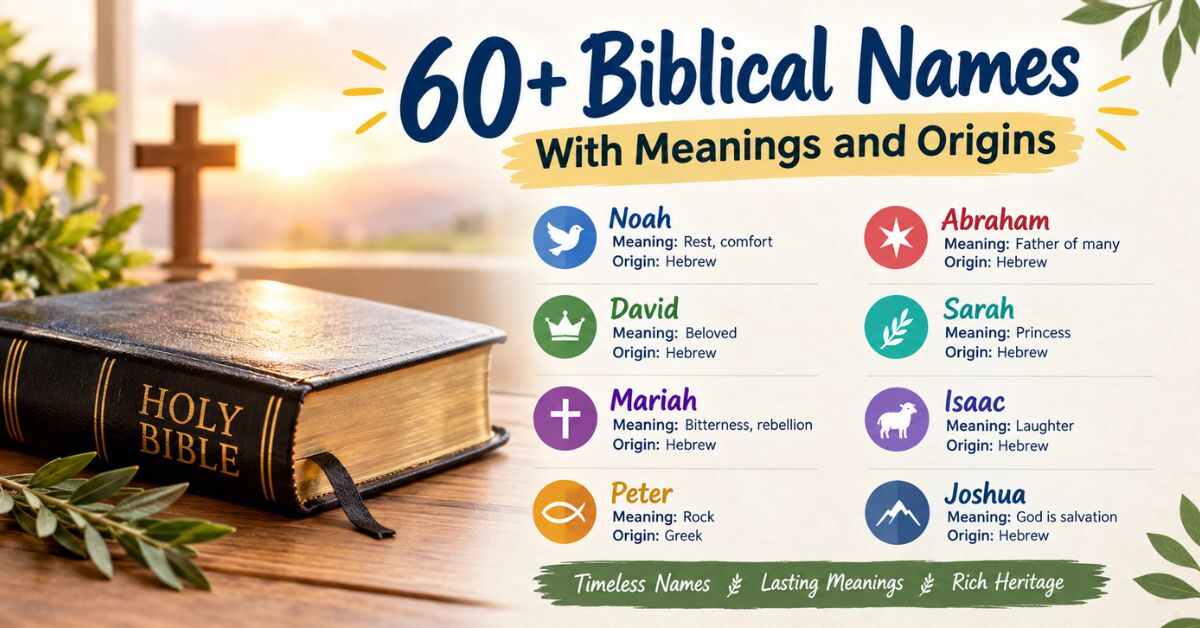
- Noah (Hebrew): Means “rest” or “comfort.” A gentle name tied to the builder of the ark.
- Abraham (Hebrew): Means “father of many.” A dignified name with Abe or Bram as nicknames.
- Isaac (Hebrew): Means “he laughs.” A cheerful name with Ike or Zac as short forms.
- Jacob (Hebrew): Means “supplanter,” and is linked to the idea of holding the heel. A classic with Jake as a friendly nickname.
- Joseph (Hebrew): Means “God will add.” A well-loved name with Joe and Joey as short forms.
- Daniel (Hebrew): Means “God is my judge.” Steady and respected, with Dan or Danny as nicknames.
- David (Hebrew): Means “beloved.” One of the most enduring names in the world.
- Solomon (Hebrew): Means “peaceful.” Tied to the wise king, with Sol as a short form.
- Samuel (Hebrew): Means “God has heard.” Warm and popular, with Sam or Sammy as nicknames.
- Elijah (Hebrew): Means “my God is Yahweh.” A modern favorite with Eli as a sweet short form.
- Joshua (Hebrew): Means “God is salvation.” A strong, familiar name with Josh as an easy nickname.
New Testament Boy Names
These names belong to the apostles and early followers. Many came into English through Greek and Latin, and they have a clear, friendly sound.
- Matthew (Hebrew): Means “gift of God.” Classic and approachable, with Matt as an easy short form.
- Luke (Greek): Linked to “light-giving” or “man from Lucania.” Short, bright and widely loved.
- John (Hebrew): Means “God is gracious.” One of the most common names in history, with many forms around the world.
- Peter (Greek): Means “rock.” Steady and strong, with Pete as a casual nickname.
- Paul (Latin): Means “small” or “humble.” Simple and dignified, and known in many languages.
- Andrew (Greek): Means “manly” or “brave.” Friendly and classic, with Andy or Drew as nicknames.
- Thomas (Aramaic): Means “twin.” Solid and traditional, with Tom or Tommy as short forms.
- Philip (Greek): Means “lover of horses.” Warm and refined, with Phil or Pip as nicknames.
- Stephen (Greek): Means “crown.” Elegant and easy to pronounce, with Steve or Stevie as options.
- Timothy (Greek): Means “honoring God.” Gentle and kind, with Tim or Timmy as short forms.
- Simon (Hebrew): Means “he has heard.” Smooth, simple and popular across Europe.
- Gabriel (Hebrew): Means “God is my strength.” Named for the archangel, with Gabe as a friendly short form.
Classic Girl Names From the Bible
Many of the best-loved names for girls come from remarkable women in scripture. These are elegant, familiar and easy to say anywhere.
- Eve (Hebrew): Means “life” or “living.” Short, striking and full of history.
- Sarah (Hebrew): Means “princess.” A timeless favorite with Sadie or Sally as playful forms.
- Rebecca (Hebrew): Often linked to “to bind” or “captivating.” Classic and warm, with Becca as a nickname.
- Rachel (Hebrew): Means “ewe.” Soft and gentle, and popular in many countries.
- Ruth (Hebrew): Often connected with “compassion” or “friend.” Short and quietly strong.
- Esther (Persian/Hebrew): Means “star.” Dignified and graceful, with Essie as a sweet nickname.
- Hannah (Hebrew): Means “grace” or “favor.” A palindrome that reads the same forward and backward.
- Naomi (Hebrew): Means “pleasantness.” Soft, musical and popular worldwide.
- Abigail (Hebrew): Means “my father is joy.” Cheerful and classic, with Abby or Gail as nicknames.
- Deborah (Hebrew): Means “bee.” A strong name for a wise judge, with Debbie or Deb as short forms.
- Elizabeth (Hebrew): Means “my God is an oath.” Regal and flexible, with countless nicknames like Eliza, Beth and Libby.
- Mary (Hebrew): The English form of Miriam. Its exact meaning is debated, with suggestions like “beloved” and “bitter.” One of the most enduring names in history.
Short and Modern-Feeling Bible Names
Some scripture names sound fresh and contemporary. They are short, stylish and easy to say, so they suit families who want tradition with a modern edge.
- Ezra (Hebrew): Means “help.” Short, smooth and popular in recent years.
- Asher (Hebrew): Means “happy” or “blessed.” Bright and upbeat.
- Jonah (Hebrew): Means “dove.” Gentle and peaceful, with a soft, easy sound.
- Amos (Hebrew): Means “carried.” Simple, vintage and full of character.
- Caleb (Hebrew): Often linked to “faithful” or “devoted.” Friendly and steady.
- Micah (Hebrew): Means “who is like God.” Compact and modern, with a calm feel.
- Gideon (Hebrew): Often linked to “mighty warrior.” Bold and distinctive.
- Levi (Hebrew): Means “attached” or “joined.” Casual, cool and popular around the world.
- Silas (Latin/Greek): Linked to “forest” or “of the woods.” Stylish and earthy.
- Jude (Hebrew): Means “praised.” Short and warm, and best known as a saint’s name.
- Tobias (Hebrew): Means “God is good.” Charming and gentle, with Toby as a friendly nickname.
- Josiah (Hebrew): Means “God supports.” A strong name with Joe or Jo as short forms.
Rare and Unusual Bible Names
If you want something less common, these names are a good place to look. They are distinctive, meaningful and rarely heard, yet they still have deep roots.
- Enoch (Hebrew): Means “dedicated.” An ancient name with a quiet, solemn feel.
- Jesse (Hebrew): Often linked to “gift,” though the exact meaning is uncertain. Casual and friendly.
- Boaz (Hebrew): Often thought to mean “in him is strength.” Bold and unusual.
- Seth (Hebrew): Means “appointed.” Short and simple, with a calm, steady sound.
- Reuben (Hebrew): Means “behold, a son.” Warm and old-fashioned, with Ruben as a common spelling.
- Ezekiel (Hebrew): Means “God strengthens.” Strong and lyrical, with Zeke as a lively nickname.
- Malachi (Hebrew): Means “my messenger.” Rare and striking, with Mal as a short form.
- Zechariah (Hebrew): Means “the Lord remembers.” Long and grand, with Zach as an easy nickname.
- Ephraim (Hebrew): Means “fruitful.” Rich and unusual, with Ephie as a playful short form.
- Barnabas (Aramaic): Means “son of encouragement.” Friendly and vintage, with Barney as a nickname.
- Bartholomew (Aramaic): Means “son of Talmai.” Long and distinguished, with Bart as an easy short form.
- Nathaniel (Hebrew): Means “gift of God.” Classic and kind, with Nate or Nat as nicknames.
How to Choose From Biblical Names
A name that looks wonderful on a list still has to work in daily life. These steps will help you decide.
Say it aloud with your surname. Repeat the full name several times. Longer names like Bartholomew need to flow smoothly with your family name.
Think about the nicknames. Scripture names come with many short forms. Elizabeth can become Eliza, Beth or Libby, while Ezekiel can become Zeke. Make sure you like the versions your child is likely to hear.
Check the spelling. Many names have more than one form, such as Ruben and Reuben, or Isaac and Isaak. Choose the version you want and stick with it.
Learn the story behind it. Every name comes with a person or event. Knowing the story helps you feel confident about your choice and gives you something to share with your child later.
Look at the initials. Write the first, middle and last initials together to make sure they do not spell something unfortunate.
Consider sibling names. If you have other children, think about how the styles and lengths sound together.
Verify the meaning. Meanings for ancient names differ between sources. Compare a few reliable name dictionaries and choose the meaning that fits your family’s story.
Try it for a few days. Use the name privately, write it down and say it out loud. If it still feels right after the excitement fades, it is probably the one.
FAQs
What are some popular biblical names?
Noah, Elijah, Sarah and Hannah are among the most loved choices today.
Do Bible names have specific meanings?
Yes, most come from Hebrew, Aramaic or Greek words with a clear or debated meaning.
Are there rare Bible names for babies?
Yes, names like Malachi, Ephraim and Zipporah are uncommon but still well rooted in scripture.
Can biblical names work for people of any faith?
Yes, many are used across cultures and appreciated simply for their sound and history.
How do I check the meaning of an ancient name?
Compare more than one reliable name dictionary, since scholars sometimes disagree.
Conclusion
Names from scripture offer history, meaning and a sense of connection across generations. Whether you love the gentle strength of Noah, the grace of Hannah or the modern ease of Asher, there is a wide choice for every taste. Shortlist five favorites, test them against the tips above, and give yourself time to decide. When you find the right one among these biblical names, it will feel like it was waiting for your child all along.