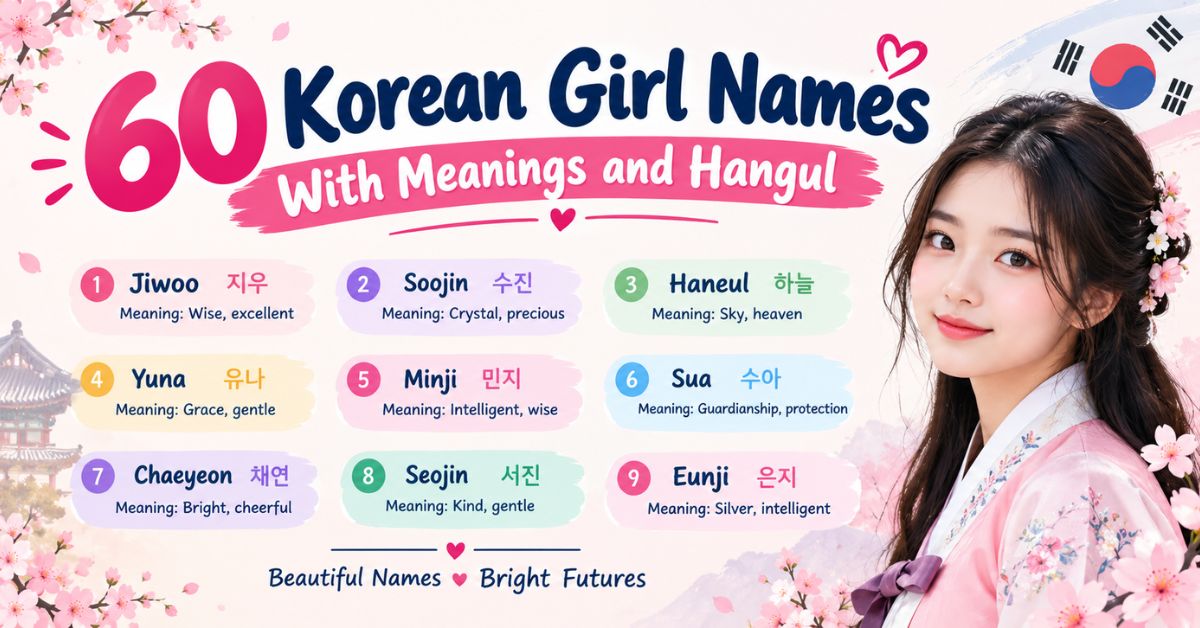
Korean baby names are admired around the world for their soft sounds and meaningful roots. Many parents outside Korea are drawn to them because they feel gentle, modern and easy to pronounce. If you are looking for Korean girl names, this list gives you 60 options, each with its Hangul spelling, romanization and meaning. The names are grouped into nature words, native virtue words, Sino-Korean classics, modern favorites and traditional heritage names. Read through each section, note the ones that stay in your mind, and use the tips at the end to make your final choice with confidence.
How Korean Names Work
Before you browse, it helps to know a little about how names are built. Most Korean names have two syllables and sit after the family name, such as Kim or Park. Names come from two sources. Native Korean names use everyday Korean words like “sky” or “star.” Sino-Korean names are built from Chinese characters called hanja, and the meaning depends on which characters the parents pick. The same romanized name can therefore carry different meanings in different families. Where a meaning varies, this list gives the most common one.
Nature-Inspired Names
Native Korean words for nature make beautiful names. They are simple, poetic and easy to remember, and they suit parents who want a name that feels calm and bright.
- Haneul (하늘): Means “sky” or “heaven.” A wide, open name that suggests freedom and hope.
- Bora (보라): Means “purple.” It is a rich, royal color and a cheerful, distinctive choice.
- Byeol (별): Means “star.” Short and sparkling, it works well as a first or middle name.
- Bom (봄): Means “spring.” It suggests new beginnings and is perfect for a spring baby.
- Iseul (이슬): Means “dew.” Delicate and fresh, it evokes early mornings and quiet gardens.
- Gaeul (가을): Means “autumn.” Warm and calm, it suits a baby born in the fall.
- Sol (솔): Means “pine tree.” A strong, evergreen symbol of endurance and loyalty.
- Nabi (나비): Means “butterfly.” Light, playful and full of movement.
- Nari (나리): Means “lily.” A graceful flower name with a soft, musical sound.
- Saebyeok (새벽): Means “dawn.” A poetic pick that stands for a fresh start.
- Yeoul (여울): Refers to a stream running over shallow rocks. Unusual and lovely.
- Gyeoul (겨울): Means “winter.” Cool and quiet, it suits a winter baby.
Native Korean Virtue Names
These names use pure Korean words for qualities parents hope their daughter will carry. They are meaningful without being heavy and often sound light and friendly.
- Seulgi (슬기): Means “wisdom” or “good sense.” A bright name for a thoughtful child.
- Boram (보람): Means “worth” or “a sense of fulfillment.” It suggests a life of meaning.
- Dasom (다솜): An old Korean word for “love” or “affection.” Gentle and warm.
- Sarang (사랑): Means “love.” Simple, direct and easy for any reader to understand.
- Miso (미소): Means “smile.” Cheerful and easy to say in any language.
- Mirae (미래): Means “future.” A hopeful, forward-looking name.
- Bitna (빛나): Means “to shine” or “radiant.” Bright and confident.
- Narae (나래): Means “wings.” It suggests lift, freedom and ambition.
- Areum (아름): Means “beautiful.” A graceful name that is short and easy to spell.
- Nuri (누리): Means “world.” A big idea in a small, friendly name.
- Hana (하나): Means “one” or “first.” It stands for uniqueness and new beginnings.
- Saetbyeol (샛별): Means “morning star.” A shining, poetic choice.
Sino-Korean Classics
These names are built from hanja, so their meanings depend on the characters chosen. The meanings below are the ones most families associate with each name.
- Ji-hye (지혜): Means “wisdom.” A classic name with a clear and admirable meaning.
- Hye-jin (혜진): Commonly linked with “wisdom” and “treasure.” Elegant and well loved.
- Eun-hye (은혜): Means “grace” or “favor.” Soft, gentle and easy to pronounce.
- Jin-ju (진주): Means “pearl.” A precious name with a lovely, rounded sound.
- Yeon-hwa (연화): Means “lotus flower.” It suggests purity and calm.
- Soo-jin (수진): Often linked with “excellent” and “precious.” A steady favorite.
- Eun-ji (은지): Commonly connected with “grace” and “wisdom.” Popular across generations.
- Ji-young (지영): Often associated with “wisdom” and “flourishing.” A timeless pick.
- Sun-hee (순희): Commonly linked with “pure” and “joy.” Traditional and warm.
- Hyeon-ju (현주): Often written to suggest “virtuous” and “pearl.” Refined and thoughtful.
- Chun-hyang (춘향): Means “spring fragrance.” It belongs to the heroine of a famous classic Korean love story.
- Min-ji (민지): Commonly linked with “clever” and “wisdom.” Friendly and easy to say.
Modern and K-pop Favorites
Many families today choose names that feel fresh and contemporary. These names appear often in school classrooms, dramas and pop music, and they are easy for international readers to pronounce.
- Ji-woo (지우): A popular modern name whose meaning depends on the characters chosen. Soft and stylish.
- Seo-yeon (서연): Frequently ranked among favorites, often linked with “auspicious” and “graceful.”
- Ha-yoon (하윤): A gentle, modern name that often combines a native sound with a Sino-Korean syllable.
- Yuna (유나): Short and international, it is easy to spell and pronounce anywhere.
- Soo-ah (수아): Often linked with “elegant” and “graceful.” Light and sweet.
- Min-seo (민서): A modern staple with a smooth rhythm. The meaning varies by hanja.
- Ye-jin (예진): Often connected with ideas of “grace” and “precious.” Stylish and poised.
- Chae-won (채원): A modern name popular in recent years. Meanings vary with the characters.
- Da-eun (다은): Often interpreted as “many graces” or “abundant kindness.” Warm and friendly.
- Ha-rin (하린): A short, breezy name with a modern feel.
- Seo-yun (서윤): A calm, elegant name widely used in recent years.
- Ji-a (지아): Very short and sweet, with a meaning that depends on the hanja.
Classic and Traditional Heritage Names
These names were common in earlier generations and still carry a dignified, warm feeling. They suit parents who want a link to Korean tradition or family history.
- Young-hee (영희): Commonly linked with “flourishing” and “joy.” A name known to many Korean learners.
- Kyung-hee (경희): Often associated with “respect” and “joy.” Dignified and kind.
- Mi-sook (미숙): Often read as “beautiful” and “gentle.” A well-known traditional name.
- Jeong-sook (정숙): Commonly linked with “upright” and “graceful.” Steady and respectable.
- Ok-hee (옥희): Combines “jade” and “joy.” A treasure-like, cheerful name.
- Bok-hee (복희): Combines “fortune” and “joy.” A name that carries good wishes.
- Soon-yi (순이): Suggests “gentle” and “pure.” Sweet and old-fashioned.
- Eun-ju (은주): Often linked with “grace” and “pearl.” Gentle and refined.
- Mi-young (미영): Commonly read as “beautiful” and “flourishing.” Smooth and classic.
- Hyun-sook (현숙): Often linked with “wise” and “virtuous.” Thoughtful and mature.
- Ji-sun (지선): Often associated with “wisdom” and “goodness.” Balanced and calm.
- Eun-kyung (은경): Commonly connected with “grace” and “respect.” Polished and gentle.
How to Choose From Korean Girl Names
A beautiful name on a list still needs to work in daily life. These steps will help you decide.
Say it aloud with your surname. Repeat the full name several times. Korean names have a smooth rhythm, so check that it still flows well with your family name.
Learn the correct pronunciation. Romanization can look different from the sound. Listen to a native speaker say the name and practice it, so you can teach others.
Check the Hangul and the meaning. Since Sino-Korean names depend on hanja, ask a Korean speaker or a trusted dictionary which characters give the meaning you want.
Think about nicknames. Two-syllable names often shorten naturally. Seo-yeon might become Seo or Yeon. Make sure you like the short forms, since friends and teachers will find them fast.
Look at the initials. Write the first, middle and last initials together to make sure they do not spell something unfortunate.
Consider sibling names. If you already have children, think about whether the styles, lengths and sounds will sit well together.
Try it out for a few days. Use the name privately, write it in your notes and say it out loud. If it still feels right after the excitement fades, it is likely the one.
FAQs
What are some popular Korean girl names?
Seo-yeon, Ji-woo, Ha-yoon and Yuna are widely loved modern choices.
Do Korean names have specific meanings?
Yes, most carry a meaning taken from a native word or from Chinese characters called hanja.
How do I pronounce Korean names correctly?
Listen to a native speaker or a trusted audio dictionary, as romanization can differ from the actual sound.
Can a name from another culture work in an English-speaking country?
Yes, short names like Yuna, Mina and Hana are easy to say and spell almost anywhere.
How do I check the meaning of a Sino-Korean name?
Ask a Korean speaker or a reliable name dictionary which hanja characters the name uses.
Conclusion
Korean names offer a lovely mix of poetry, meaning and sound. Whether you prefer the sky-wide calm of Haneul, the wisdom of Ji-hye or the modern charm of Seo-yeon, there is a great deal of variety to choose from. Shortlist five favorites, test them against the tips above, and give yourself time to decide. When you find the right one among these Korean girl names, you will know.